Apr 1, 2011

ImpromptuSpace

0 Comments


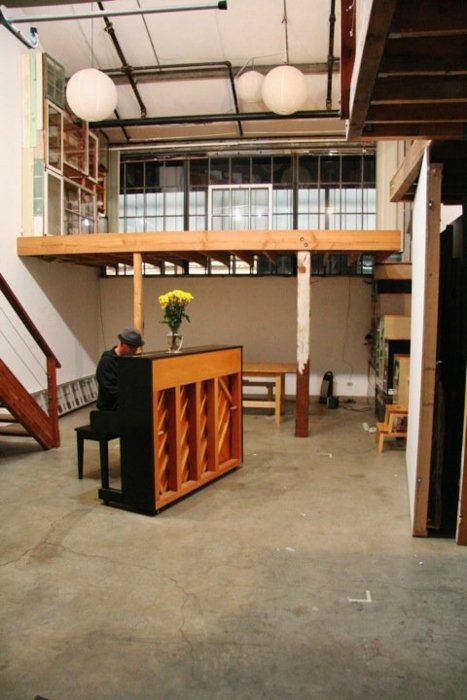
Gary St. Frankenstein playing the piano.

I have created a temporary popup event space in two unusual 1,000 square foot industrial units in the heart of Dogpatch, San Francisco. ImpromptuSpace will host a series of art events and performances for two months.

See impromptuspace.tumblr.com for more.

Jan 17, 2011

Manual or Automatic?

0 Comments


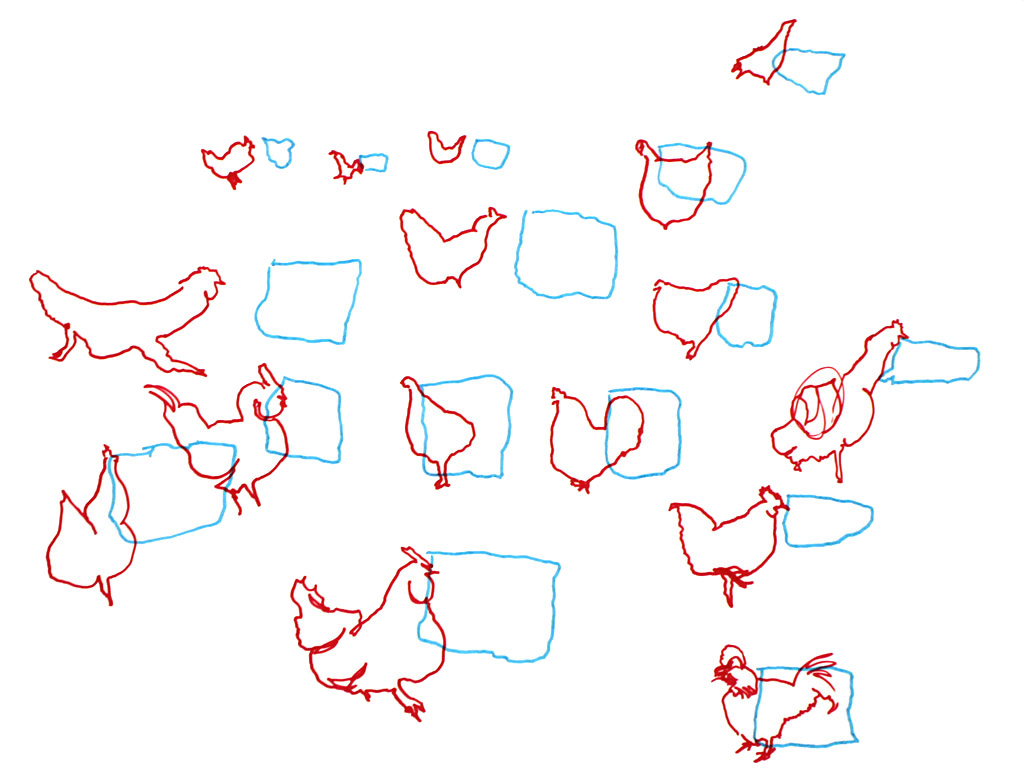
Chickens by left hand, squares by right hand, simultaneously, while wearing 3D glasses. Ink on paper, 22 x 17", 2010

Jon Meyer’s exhibition, Manual or Automatic?, considers the history and the future of the human hand. Industrial automation has dramatically altered the role of the hand in contemporary life, leading paleontologist AndrĂ© Leroi-Gourhan to conclude that in the future the hand may regress until it is no more than an index finger with which to push buttons. Responding to this provocation through anaglyph drawings, a mural-sized installation, biographical objects, geometric paintings, algorithmic and software-based works, Meyer tests the bounds of his own neuromotor capabilities, and considers his complex personal relationship to histories of manual labor.

Meyer recently began a PhD in Art Practice at Goldsmiths College, London. He is a visiting artist at California College of the Arts, teaching in the Graduate Fine Art, Critical Studies, and Graduate Design programs. A recipient of a 2009 NYFA Artists Fellowship award, Meyer has exhibited in London, New York, Seattle and San Francisco. This is his first large-scale solo exhibition.

With thanks to CCA's Division of Humanities and Sciences and Professor Rachel Schreiber for making this exhibition possible.

Tecoah Bruce Gallery at the Oliver Art Center, CCA Oakland campus, 5212 Broadway.
Reception: Wed., Jan. 26, 5:30–7:30 p.m.
Hours: Mon.–Fri., 8:30 a.m.–noon and 1–4:30 p.m. (closed Wed. morning);
other times by arrangement with the artist.

Dec 18, 2010

Upcoming Oliver solo show

0 Comments

I have a solo exhibition titled Manual or Automatic? at the CCA Oliver Arts Center in Oakland, California from January 21-31, 2011. The public reception is on Wednesday, January 26th, from 5:30 - 7:30. link.

Dec 17, 2010

Error, Fate, Chance

0 Comments


Shotgun blast (the longest path between fifty points), Charcoal and pricing stickers, 20' x 12', 2010.

I have an installation at Work Gallery as part of the exhibition Error, Fate, Chance. The show opened Nov 12 is now extended through Jan 16th. See WORK Gallery for more.

Dec 16, 2010

Bad Things that could happen

0 Comments

Bad Things That Could Happen from This Is It on Vimeo.

From This is It, a collective of illustrators, animators, artists and designers based in London. Thanks Erika.

Dec 1, 2010

CogSci in Pop Culture

0 Comments

In my Body and Cognition class in 2009, I asked students to send in links to things they found on the web that they felt were relevant to cognitive science. Here's what they came up with:

Cartoons

Pinky and the brain
Song in which Pinky and the brain describe the parts of the brain.

Visualizations

How the Body Works: The Regions of the Brain
Narrated animation: "The brain has three functional and anatomical parts…"

Neurotransmitter Synapse 3D animation

3D computer graphics animation of an action potential traveling down an axon

Hybrid Medical Animation
Simple 3D computer animation of a DNA molecule

Action potential animation
3D animation of cells and action potential

School Projects

Brain Tumors
A school student creates a narrated video with cartoon figures, describing medical facts around brain tumors.

Piaget’s Stages of Cognitive Development
A school student creates a talking-head account of Piaget's stages of Cognitive Development.

The Right Brain vs. Left Brain
An optical illusion that tells you which side of the brain you use more.

Metaphorical / Art

Sensory Neurons
A metaphorical animation that uses stop-motion to illustrate the moment between touch and feel.

Sounds of Complexity
Audiovisual performance where crude sounds of the brain are monitored then transformed into frequencies.

Sounds of Complexity 2009
Continuation of above. Material is processed digitally in real-time, frequencies are transformed into Cartesian space to form visual trajectories on screens that react dynamically.

Health Education

What causes Epilepsy? (Epilepsy #5)
A health education video on the causes and effects of epilepsy.

Promotion/Advertising

Honda Develops Brain Machine Interface
Promo piece by Honda: Using the brain to remote-control things by thought alone. Technology showcase of current state of the art.

Sex, drugs and Rock'n'Roll center in the brain
Promo piece by Philips about how rock and roll music stimulates the reward center of the brain - the same way that sex and drugs do.

The Many Faces of Toni Collette in “Tara”
An Associated Press introduction to "United States of Tara", Showtime series from Steven Spielberg and Diablo Codya, featuring an interview with the show's star, Toni Collette.

Popular Science

Human Body: Pushing The Limits
Discovery: Too often we take our bodys for granted, but under presser our bodies can show how extraordinary they are". Uses 3D to illustrate full of hyperbole "our brain can slow down time and unleash immense power."

Super Brain Yoga
Channel 2 news feature about a form of exercise that is claimed to "pump up" neural activity in the brain and turn people into Grade A students.

Your Brains on Sex
When we have an orgasm, the limbic system releases the highest legal of dopamine in the brain - the same chemical released by Heroin.

Brain Controls Pain
Short video about how doctors are teaching patients how to manage pain through brain control.

Making Brain Cells
Science feature by ScienCentral on genetically modified mice, and the similarities between skin and brain stem cells. Claims that that the brain stem cells and hair follicle stem cells can both form into neurons. Could have long-term medical implications.

Crush the myth about Hypnosis, find out the truth today
A Mythbusters test about whether pypnosis helps three subjects remember details of a staged scene. Conclusion: they do have enhanced recall.

Remember Name hypnotically with Wendi
Self-help video in which Wendi tries to use hypnosis techniques to help people remember. Claims "things are stored in specific places in the brain."

Optical Illusions Show How we See
A TED presentation by Beau Lotto where he shows several optical illusions to illustrate that we don't see "reality" but a filtered version of it.

Feature Films

Ghost in the Shell (philosophical scenes)
Three philosophical scenes from the feature animation "Ghost in the Shell". The main character's memories are shown to be faked - raises questions of identity and subjectivity.

Waking Life Clip: Ants
A segment of the film waking life. "I don't want to be an ant" - female character asks male character for a more human connection.

The Cruise
A clip from the film The Cruise. Timothy Levitch a NY bus tour guide singing. "This is the first real day of their lives" - Timothy talks about cruising manifestations and connecting with tourists.

Mindgame Clip: God
A clip from the film Mindgame, in which the main character dies and meets God.

Documentaries

Music and the Brain
A clip from a lecture at the library of congress by Daniel Levitin. He presents an argument that music came before language.

Science Bulletins: Language and the Brain
An American Museum of Natural History mini documentary on speech and language in the brain.

Cognitive Psychology: The Brain
A ten minute clip from a longer KPBS documentary on learning and brain plasticity. "The brain is capable of rapidly revising..."

Dissociative Identity Disorder
A day-in-the-life style documentary about a man with dissociative identity order.

Kim Peek – The Real Rain Man
A documentary about Kim Peek, the savant who inspired the Rain Man. "He's become a living Google." Talks about his emotional life, his relationship with his father, and his cognitive abilities.

Savant Drawings
Documentary about Stephen Wiltshire, a savant who has perfect visual recall. He creates a near-perfect drawing of Rome after only seeing it from a Helicopter.

How to Improve Your Memory -2
Part of a British documentary about change blindness, memory and attentiveness.

US Language Attitudes
A documentary by Dennis Preston's on what people believe are "correct" and "bad" accents in American English.

East of Krakatoa - John Kang
Clip from the documentary Ring of Fire: East of Krakatoa. Appears to show John Chang, a meditation expert, creating fire only with his hand.
Oct 27, 2010

Design as intervention

0 Comments

I recently attended a series of presentations by designers who were invited to create "interventions" in public space.

I've been thinking about this since then, and especially about the concept of design as intervention. Is "intervention" a valid or appropriate strategy for design?

Interventionism is where one group disregards another group's right to self-determination in order to forward the first group's moral agenda and sovereignty. There are clear cases where interventionism is accepted, e.g. to prevent genocide. However, in the case of a designer intervening in a space or situation through a designed artifact in order to forward that designer's moral (or technical) agenda, we have to be more careful. "Intervention" has an activist ring to it, but when employed by those equipped with the tools of mass production, it quickly becomes hegamonic.

In particular, I wonder what criteria is used for evaluating a given intervention? Designers talk of objective functions for measuring the consequences of an object in line with their agenda. For example, if a designer were to publish a series of leaflets on waste disposal they might adopt an objective function that measures the resulting increase in the use of recycling bins. Although these types of objective measurements are appealing, they are often misleading. I'm reminded of Thomas Midgley's invention of Tetraethly Lead (TEL), a gasoline additive that had important benefits measured in the metrics of the day (it reduced engine "knocking"). It was only years later that we discovered the disastrous secondary and tertiary consequences of this change. Another example is plastic bags, which in the objective measurement function of their day were cheap, lightweight, and strong. Today we have a new artificial island in the Pacific that is made up from this cheap, lightweight and strong.

Interventionism applies a cause-effect analysis that fits well with the service-based ethos of design: Have a problem? Identify a solution, create an intervention, measure the improvements, iterate. How does this address a complex ecosphere? It is unclear, since the designer in this scenario is placed on the outside, as a lone agent with little real accountability for the secondary and tertiary effects of their work.

I realize I am being rather cynical. Certainly I often enjoy encounters with social interventions. I especially relish the bizarre, strange and unexpected. But the strategy of interventionism seems stuck in a colonial imaginary, one that relies on a construction of self and other. What other strategies are possible? What about design for the subaltern, for example?

Thinking about this (and this is very unformed), Daniel Eatock represents one place to start. Eatock is an independent artist with a design practice (or is it the other way around?) He offers a materials-based conceptual take on design. His manifesto on his website is:

Begin with ideas
Embrace chance
Celebrate coincidence
Ad-lib and make things up
Eliminate superfluous elements
Subvert expectation
Make something difficult look easy
Be first or last
Believe complex ideas can produce simple things
Trust the process
Allow concepts to determine form
Reduce material and production to their essence
Sustain the integrity of an idea
Propose honesty as a solution

His approach is deceptively simple. His model is collaborative and at the same time he asserts his independence. He does have large clients (e.g. Channel 4), but he is selective in his choice of clients, and insists that they work within his creative model, rather that designing to a brief. "there is no brief, no description, no guidelines.... If criteria were written down, they would be restrictive." Eatock's approach downscales design and takes it out of a solution-oriented framework. He doesn't make any claims about interventions or about measuring results.

Discussing Eatock in class last year, one student proposed taking the idea of an independent designer further: What about a designer who creates designs for just one other individual? Or a designer who creates artifacts for one very small community or village? Returning to these highly embedded and communal models is a counterstrike against design for the masses.

Finally there is APG. Claire Bishop wrote about the Artist Placement Group in this months ArtForum (link). The APG was a group in the 1960's which placed artists (or "Incidental Persons") within organizations. The motivations of APG's founders, John Latham and Barbara Stevani, were intentionally precarious. Rather than aiming for a specific identifiable outcome, the Incidental Person was viewed as a figure who "takes the stand of a third ideological position which is off the plane of their obvious collision areas." In other words, rather than occupying known positions, it was an attempt to intentionally create unknowable positions.

The APG makes a mockery of activism since, although their aim was to achieve change, they were unconcerned with the ideological direction of that change. Instead they measured the change produced by their placements in terms of what they called the "delta unit", which had factors like the number of people affected by a change, or the length the change lasted. At first this seems absurd - how can you be for any change whatsoever? But what the delta unit does is force us to take a much longer view on assessing change. It prevents us from pre-determining an objective function based on naive causality.

The APG is a call for experimentation that is intentionally unplanned, where evaluations are performed a long time after the fact. If I were an interventionist, this is the kind of agenda I would want to impose on design.

Oct 11, 2010

PhD induction week

1 Comments

Last week I started my MPHIL/PhD in Art Practice at Goldsmiths College, University of London. I had my first meeting with my supervisor at Goldsmiths, professor Suhail Malik. I also recently met with Joseph Tanke, a philosophy professor at CCA who is co-advising me in San Francisco.

The working title of my thesis is "The fate of the hand." This is a section heading of the book Gesture and Speech by paleontologist André Leroi-Gourhan. In the book, Leroi-Gourhan argues that in the future the hand may regress to simply an index finger to push buttons. Machines will take care of the rest. Against this prediction, in my thesis I plan to examine many possible scenarios for the future hand.

So what am I reading? In art theory, I'm starting with Heidegger, and the 2002 book Tool-Being by Graham Harman, who aims to rethink Heidegger's analysis of the tool. Harman is one of a group of philosophers arguing for "speculative realism" - the first time since Kant that there has been a concerted push to advance a realist position, rather than the myriad relational positions found in philosophy from Kant to Deleuze.

I've also begun reading neuroscience papers. Cognitive scientists, like speculative realist philosophers, have shown a renewed interest in the relationship between mind and reality, and there are now entire conferences dedicated to "embodied cognition," which aims to study thought without isolating it from body states. It can be no accident that these two groups, with very different historical trajectories, have both zeroed in on the mind-body problem. The connection, I am certain, will be found in Flying Spagetti Monsterism.

Things I learnt last night

0 Comments

Yesterday, my friend Scott pointed out two factoids during a party to celebrate 10/10/10:

1. 101010 = 42. Which of course is a very important number.

2. The volume of a pizza whose radius is z and whose thickness is a = pizza. Which is perhaps only important when you are hungry.