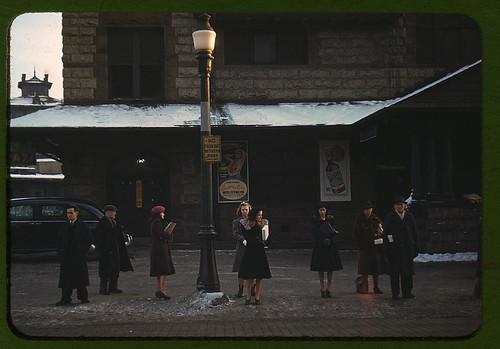
Commuters in Lowell, Mass, 1941.
The US FSA black and white photos are well known, but personally I love this old and quixotic photo set of color photos from the 1930s-40s.
Commuters in Lowell, Mass, 1941.
The US FSA black and white photos are well known, but personally I love this old and quixotic photo set of color photos from the 1930s-40s.
“I live and breathe this stuff, and I’m bored,” she wrote on Twitter.
Update: Data from Pew research shows that, in the case of TV news, news reportage has dramatically dropped in favor of opinion shows.

I saw a poster on the wall with this quote:
Those who do not move, do not notice their chains -- Rosa Luxemburg.
Later the same day I went to a lecture where Nietzsche was quoted:
"Free will" really means nothing more than the absence of feeling of new chains. -- Friedrich Nietzsche, The Wanderer and His Shadow, 1880.
Strange coincidence.

I am giving a short talk at Berlin's Pecha Kucha night. What is Pecha Kucha? Around 200 people come to hear between 10 and 15 short talks. Every talk is the same format: 20 images, 20 seconds per image, 6 minutes 40 seconds. The talks cover a range of topics and are in English and German. I will give an overview of some of my research for my PhD.
Pecha Kucha #27
Festsaal Kreuzberg
Skalitzer Str. 130 • 10999 Berlin,
Einlass / Beginn: 19:30h / 20:20h,
Eintritt / Entrance: 6 Euro.
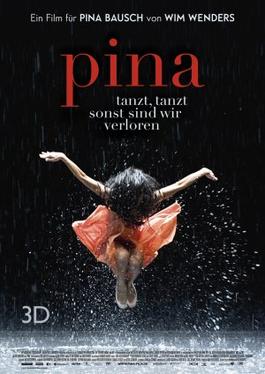
Pina Bausch is divisive. Some adore her work. Others reject it as sexist, classist, and cruel (or "torture" as Joan Acocella states in her New Yorker review). For me, if cruelty is present in Pina's work, it is there in an Artaudean sense, not a literal one (by the same token, would these people likewise say Monty Python is about torture and humiliation?). Watching Wim Wenders personally introduce his film, and listening to the interviews in the film, it is striking how Pina is surrounded by love. In one moving moment, a dancer points out (I'm paraphrasing) that Pina had watched her for more hours than her own parents had... who would watch her now? For me, it is Bausch's watchfulness that informs her work, not any desire to depict torture.
Of Wender's film I had mixed feelings. The way the interview segments cut into the dance segments often left me frustrated. Some of the interviews appear to be included for inclusiveness' sake, rather than because they inform us about a new aspect of Pina's life. I didn't like the 3D: I would have preferred to see the images brighter and clearer and without the reflections of smeary plastic glasses in front of my face. And where Pina's performances were peppered with textual elements, these were largely missing from Wender's tribute. All this said, I left the film with the same sense I have when I went to see Pina at BAM. Yes, I remain very resolutely a Pina fan.
What most impressed me about Maurizio Cattelan: All at the Guggenheim was the way it visually held together. It is remarkable how consistent Cattelan was over the years. Where other artists increase their showyness with their fame, Cattelan's work retains a certain scale of production throughout, speaking of a level of discipline that rubs against his reputation as a prankster. It was a forceful and utterly convincing show. And we must wonder whether 'All' is all, or if the title is just another prank. Both make sense - and this, really, is the point.

I recently visited two of my favorite bookshops in New York, St Marks and the Shakespeare & Co on Broadway. Both shops used to have great philosophy sections. Now they have adopted the approach of presenting larger format books, and turning many of the books face-out. Consequently they now they carry a far smaller selection, barely anything beyond the top-of-the-pops. They've eliminated the one reason why I love going to bookshops: when you search for a specific title, you often find lesser-known works shelved nearby. Now, rather than a dozen books on a particular topic, the shelf only displays two or three. The bookshops appear to have ceded diversity to the Internet, and focused instead on the appearance of ease of access. It is a massive loss for readers.
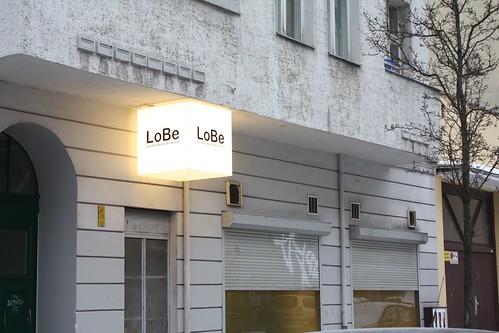
I have been selected by curator Elke Falat to be a resident at LoBe. Founded by Olivia Reynolds, LoBe is project space and gallery in Wedding, Berlin. I will be resident for the month of February, collaborating with artist Ulrike Mohr. We will create artworks that responds to the space, to each other, and to the Berlin context. There will be a gallery opening and dinner at the end of the February to celebrate the resulting artworks, which will be exhibited for three weeks during March.
For images of past exhibitions at LoBe, see their Flickr Stream.

 Posts
All Comments
Posts
All Comments


