Showing posts with label Curating. Show all posts

Jun 12, 2011

Venice Biennale 2011

0 Comments


Start the morning with a Caffe del Doge. It *is* worth hunting for. Almost up there with Blue Bottle coffee in San Francisco!

Crowding onto the morning vaporetto.

For me the most lasting impression from the Venice Biennale 2011 is Jennifer Allora and Guillermo Calzadilla's American pavilion, “Gloria”. It was a refreshing encounter. Most of the works in the pavilion resonate, and together they make a provocative exhibition. The tank piece in particular is great to talk about, look at, listen to… I want one.

Recurring themes this year: Heavy closed-loop industrial machinery (French, American, Israeli, Slovenian & Turkish pavilions); Anything plugged in; Performance everywhere but never when I was there; oh, and lots and lots of talking-head video - so much so that, at Marco Polo airport, I mistook the instructional video at the security gate for yet another artwork.

Missing this year: Any serious attempts to recuperate painting, with the exception of Seth Price’s paintings in the Central pavilion.

Allora & Calzadilla's American Pavilion. Maximal restraint. And really good legs. The tank piece is also theirs (see the video I posted)

Live performance in Allora & Calzadilla's American Pavilion

Impressions

Below are the words I jotted down for each pavilion as I went around – Its fleeting, unedited and flippant.

Giardini

Swiss crystal excess. Someone gave Hirschorn too much money.

Denmark. “Speech matters”. Not.

Nordic / Eriksson. Oh D&E where are you now?

Tank. Brilliant.

Venuzuela. Bassim pop tarts.

Russia. Monastryski mystery and substance, served dry.

Japan / Tabaimo. Dreamy animations with mirrors.

Korea / Yong Baek. Flower gun disaster.

Germany / Schlingensief. Egomania confronts blasphemy. I love this.

Christoph Schlingensief's German pavilion - I liked the little touches, like changing the label from Germania to Egomania, and adding a 'Kino' grafitti tag on the side.

German pavilion - Christoph Schlingensief's installation is astounding.

Another view of the Christoph Schlingensief's German pavilion


Canada / Shearer. Not for me.

Australia / Armanious. Trying too hard.

Britain / Nelson. Theme park made of dust.

France / Boltanski. Trumped by the tank.

Dutch. Opera without the melodrama.

Spain. “The inadequate”. Just so.

Israel / Landau. Didactic rises to new levels and goes underground.

Poland, Egypt, Romania. Worthy, but the Romanian’s grafitti should have been applied to all three.

Romanian Pavilion (Adrian Bojenoiu, Alexandru Niculescu). The 'why not' reasons were better than the 'why' reasons on the other wall, and better than what was inside.

Central pavilion

A slightly disheveled anti-statement that made Catelan’s stuffed pigeons the best statement of all. Oh. and Nathaniel Mellors videos.

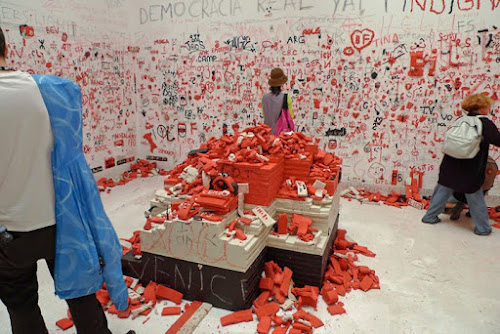
Minimalism meets relational aethetics. Norma Jeane, #Jan25 (#Sidibouzid, #Feb12, #Feb14, #Feb17…) (2011), colored plasticine (Central pavilion).

Arsenale

After the Giardini, on to the Arsenale. Song Dong's mirrored chinese closet doors were very Wong Kar-Wai .

Song’s cupboards are a great start. Marclay’s Clock is a great end. Turel’s space glows in the middle, though for me it was ruined by the attendant who insisted on standing right at the front, thereby destroying the effect (apparently someone had fallen off the edge).

A picture of my iPhone with Marclay's "The Clock" in the background. This was a perfect capstone to the Arsenale. I watched for about half an hour, I could have stayed all day.

Elsewhere - Picks:

Hirst deconstructed by Wu Rigen, in the Future Pass exhibit (17 on the maps). It was a fun pavilion if you like anime.

Nicole Knauer's cloud in the Future Pass pavilion.

Irwin Wurm's house, next to the bridge at Academia. The large guy with a blue top is unfortunately not part of the exhibit.

Yes, that is a block of watermelon on the floor. (Wilfredo Prieto, Future Generation Art Prize pavilion).

Karla Black, Scottish Pavilion. It is much better than it photographs.

Melanie Smith's Mexian pavilion showed incredible scope.

Nato a Venezia is thought provoking and the setting is cool. Talk to the gallery guides upstairs to learn more about this exhibit.

Also notable: Iraq / Abidin’s light saber battle. And Haiti by the waterfront: Glad to see them here.

Mar 12, 2010

Chus Martinez

0 Comments

"The best aerobics for the brain is to see exhibitions" - Chus Martinez

Today: a presentation at CCA by Chus Martinez, currently chief curator of Museu d'Art Contemporani de Barcelona (MACBA), previously the director of the Frankfurter Kunstverein. The talk was refreshingly rich and cerebral. In contrast to Carolyn Christov-Bakargiev, a fan of randomness who claimed curating is like being a traffic director, Martinez rooted her museum curating in the conceptual, saying at one point "the museum can only be about one thing: research." For Martinez, curatorial research is a vehicle for revisiting the near past, not for nostalgic purposes, but rather to bring it to the present and ask how it can move us now.

To expand this idea, Martinez turned to philosophy, starting with a YouTube clip of Heidegger from 1969, discussing the future of thought:

"No one knows what the fate of thinking will look like. In a lecture in Paris in 1964, which I did not give myself but was presented in a French translation, I spoke under the title: "The End of Philosophy and the Task of Thinking." I thus make a *distinction* between philosophy, that is metaphysics, and thinking as I understand it. The thinking that I contrast with philosophy in this lecture—which is principally done by an attempt to clarify the essence of the Greek "aletheia" (unhiddenness) — this thinking is, compared to metaphysical thinking, much simpler than philosophy, but precisely because of its simplicity it is much more difficult to carry out. And it calls for new care with language, not the invention of new terms, as I once thought, but a return to the primordial content of our own language, which is, however, constantly in the process of dying off.

A coming thinker, who will perhaps be faced with the task of really taking over this thinking that I am attempting to *prepare,* will have to obey a sentence Heinrich von Kleist once wrote, and that reads "I step back before one who is not yet here, and bow, a millennium before him, to his spirit." - Heidegger

Martinez said we are still trapped in the logic of dialectical thought. The dominant notion of culture remains Adorno's, wherein culture is understood in negative terms as a dialectical defense against the market and capitalism. Click. In this mindset, culture is whatever is antagonistic towards the market, and the museum acts as a shelter, protecting culture from the market.

Taking up Heidegger's quest, Martinez asked how we can move beyond dialectical logic. "What is this future of thinking? How does it work? What do we want with all that?"

One offering is relational art. In an insightful analysis, Martinez noted that the arrival of relational art, identified in Bourriaud's book Relational Aesthetics, was not an accident: relational art arose as a response to the fall of communism. Click. We cannot separate relational art of the 1990's from the collapse of the Berlin wall since, in the post-communist era, artists sought a less negative model of culture, one that embraced participation, a kind of enthusiasm, "a new happiness in a landscape of grayness," "lets do it together."

Martinez again raised Heidegger's challenge: how do we move beyond this enthusiasm, to a future of thinking?

She cited as one inspiration Deleuze's last book, Pure Immanence (see review). Martinez noted that traditional philosophies based on the transcendent produce a divide: Some objects are so powerful that they overwhelm thought, producing only experience. Click. With other less powerful objects, thought is superimposed on the object, but transcendent to it - Martinez referred to this as the October syndrome. Deleuze offers a third possibility, pure immanence - not thinking about (i.e. superimposing thought on an object) but thinking through an object.

Deleuze's theory aims to be an empiricist's riposte to rationalism and idealism. Deleuze argues that underlying rational thought there is a plane of immanence that unifies concept and experience. But Pure Immanence is evasive and incomplete. Click. What does it mean to "think through", for example?

Martinez offered imagination as a way to formulate the conduit between object and thought. Martinez distinguished imagination from fantasy. Where fantasy is static, like a frozen image that you hold in your head, imagination is active. It is speculative.

Martinez she said a freaky question is: can you imagine talking about love but using a technical language, not the language of love? Can you superimpose a logic within another logic? With this, Martinez turned to writing. She claimed writing is an immanence exercise. Fiction, she said, empowers imagination, it is an expanding act. She told the story a studio visit she had with an artist who mentioned having written a novel. This spiraled into a project (a project, she noted, not an exhibition) where she collected novels by over 200 artists and presented the collection in a reading room at MACBA. Click. Click. These novels are not published literature and therefore become something else - a "power weapon" to open a space for speculation. Someone asked "who reads them?" Martinez said "nobody," but quickly countered that she had read all the books in the collection.

*

As an artist, I found it curious to hear an art curator linger on writing. For a while it blotted out everything else, distracted as I was trying to grok how a collection of fiction which nobody reads could be the future of thought. Where does this leave art?

Later, revisiting (to use Martinez's word), I thought about the ground that was covered. What Martinez presented was a well-rehearsed theoretical track from the Frankfurt school - Adorno and Heidegger - to Deleuze. As Martinez noted, these are not new ideas.

Click. What was much less rehearsed in Martinez's talk was her use of media. Throughout the hour, Martinez showed images, sometimes pausing on one image for a long time, other times flicking through several images quickly, almost casually. Sometimes the images synchronized with what she was saying, other times not. On occasion she looked at an image and explained what the image showed. Other times not. At one point she opened a PowerPoint deck with 150 slides and started clicking through the images. "Powerpoint slides all look the same" she said, shuttling through ten images of past shows. "This was our John Cage retrospective."

And on Heidegger, Martinez showed an 8 minute video in German with no English subtitles. Afterwards, she pointed out that she knew the words by heart, but wanted to read them to us - so she opened a Word document and read the English translation. In a short moment, then, a YouTube clip; Martinez's citation of her memory of the text; a Word document showing an English translation of the text; and her performance of the Word document out loud.

This was new for me. Curators often have a reverential attitude towards images, and are more casual towards words. Martinez was the opposite. She signaled that media images are not the art, could never be the art. Media and memory fold together in complex ways that cannot be trusted. Language is more reliable.

I left with two questions.

First, although Martinez argued for expanded thought, I felt in many ways her presentation remained hermetic, focusing on the French and German thinkers who appear in all art curricula. To expand thought, isn't it now time to move to the diaspora of thought beyond the tradition of the European? I wondered about cognitive philosophy, particularly recent research on embodied cognition, or tribal thinking, as powerfully articulated by Donna Haraway.

Second, although Martinez flirted briefly with pure immanence, her presentation was fundamentally an epistemological enquiry - her central question was "what about the future of thought?" She stressed the individual thinker, and talked about alternative logics. But why thought, logic, language? What about the ways that art performs as phenomenological, ontological and communitarian activities? These today seem far more significant, yet remain less represented than epistemologies of art.

At one point, Martinez said "The best aerobics for the brain is to see exhibitions." I think this sums it up. It is not enough to see slides of exhibitions in a lecture hall, to hear words or see images. Media produces alienation. Instead, we must carry our brains (literally, not only our minds) to the exhibition itself. Doing so produces aerobics, a group body-brain activity. The importance of community and body were implicit throughout Martinez's talk, but rarely foregrounded.

Nov 3, 2009

The criteria of curating

0 Comments

Fridericianum - site of Documenta (link)

I went to a presentation at CCA by Carolyn Christov-Bakargiev, curator for the next Documenta. Erudite. Talented. Charming. Her talk made my blood boil. Carolyn claimed that she does not "select" artists for her shows. She repeatedly rejected that word. "Addition" she said, "I work through a process of addition, not selection." She said she adds artists in a way that is very chance driven, through random encounters that would lead her to work. Her shows, she claimed, were formed in this happenstance of accumulation.

I appreciated Christov-Bakargiev's effort to distance curating from the image of an all-knowing judge who selects the best work with a kind of pre-planned foresight, like a scientist performing selective breeding. But her model of chance-based addition presents its own problems. The word "add" is suffused with positivity. It glosses the unavoidable: the calculus of curating is far more subtraction than addition, since there is always less space than art. Curating inevitably involves rejecting some artists that would otherwise fit because there are other artists who otherwise fit... in other words, selection. The word "add" projects mathematical neutrality, not the shopper adding products to their shopping basket. And the idea of a curator of Documenta who "randomly" discovers artists struck me as very optimistic about the neutrality of chance. Invite a curator to your art school, pay a stipend, and see if the curator perhaps randomly meets some of your MFA students.

I left the talk hungry for criteria for curating that escape the toxicity of pluralism, without resorting to Iron Chef. Then I remembered that I'm an artist. Thank goodness I don't have to worry about that.

Apr 12, 2009

New Museum - Younger than Jesus

0 Comments


AIDS-3D. OMG Obelisk, 2007.

I did a very quick tour of YTJ at the New Museum this weekend. I really enjoyed much of the art. Ryan Trecartin's piece gave me a huge smile. I am excited this is showing near me. I plan to go back and may find time to post more.

However something Holland Cotter said in the NYTimes review resonated with me:

“Younger Than Jesus” doesn’t have a comparable sense of unity, texture or lift. It is, despite its promise of freshness, business as usual. Its strengths are individual and episodic, with too much work, particularly photography, making too little impact. But my point is that beyond quibbles about choices of individual works, it raises the question of whether any mainstream museum show designed to be a running update exclusively on the work of young artists can rise above being a preapproved market survey. Removed from a larger generational context, can such a survey ever become a story, part of a larger history? (The same question applies to museum exhibitions that leave young artists out of the picture.) I’m asking. It’s a complicated subject. I don’t know the answer.

I wonder the same thing.

If the YTJ show has a story, it is one of pluralism. The curators have done everything they can to be inclusive - consulting 150 "experts" facebook-style, listed in the published materials (I applaud this enormous effort); publishing a directory of 500 artists (also a great thing); including every form of art, from performance, video, sculpture, painting, photography and computer software; bringing in art from dozens of countries... all this demonstrates how connected everything is, how every attitude, image, form, or expression is equally valid. Every position is represented. Pluralism reigns supreme.

Yet as soon as the curators decide to divide artists into two classes based on a gambit like "younger than Jesus", they expose how shallow pluralism is in practice. The focus on the young/hot market segment does little to increase the overall pluralism in art, rather, as Holland Cotter remarks, it is business as usual. This is, as Hal Foster once said, "the false pluralism of the posthistorical museum, market and academy in which anything goes (as long as accepted forms predominate)." In the book Art Power, Boris Groy points out that pluralism is misguided, since any attempt at pluralism fails as soon as the curator has to make a choice who to exclude: "the alleged pluralism of modern and contemporary art makes any discourse on it ultimately futile and frustrating. This fact alone is reason enough to put the dogma of pluralism in question."

Of course, I may be getting this all wrong. I hold out hope that the curators are fully aware of this, and that if I spend more time in the show I will discover moments of irony that show how generational labels often collapse (perhaps they included an artist who is only fifteen, or one in their nineties?).

Mar 28, 2009

Altermodern

1 Comments

[published in ArtArtArt Issue 6 | The New Cultural Imperialism]


I saw the light, B/W photographic print, Lindsay Seers, 2005.

In Lindsay Seers’ moving video documentary of her life, shown in the Altermodern exhibition at Tate Britain, we are told by several narrators of the artist “becoming the camera” and later “becoming the projector”. These two becomings involve Lindsay placing a piece of film in her mouth to form an image, or strapping a projection device to her head to project light out into the world.

Nicolas Bourriaud, curator of Altermodern as well as writer and theorist, seems particularly drawn to these types of transformations today. Listing more examples, he writes in the exhibition catalog of how Simon Starling relocates a piece of furniture from one continent to another by radio waves, Katie Paterson transmits silence from the Earth to the Moon and back. And Darren Almond teleports bus shelters from Auschwitz into the gallery.

None of these becomings actually took place. Just as, this morning, when I filled my mouth with water, I did not become a water bottle. In common language, words like “camera” and “teleport” are too specific to bend this far.

What Altermodern proposes, through language and imagery, is a lyrical take on contemporary art – one where the artist becomes a poet or a shaman figure, capable of performing mystical transformations, living a nomadic lifestyle. We see in the exhibition catalog Shezad Dawood and Olivia Plander use imagery of American Indians, and Sparticus Chetwynd writes of rituals and of entering into a state of trance. But perhaps the clearest example of this nomadic theme is artist Marcus Coates, who literally dons animal outfits and performs shaman rituals, as confusing as they are funny.


Badger-skin headdress: Firebird, Rhebok, Badger and Hare by Marcus Coates 2008, from the Telegraph review of Altermodern.

The poetic tone in Altermodern is a new departure for Bourriaud, whose earlier theorizing is far more operational. In his book Relational Aesthetics (1998) Bourriaud describes how Christine Hill works as a checkout assistant, Cattelan feeds rats cheese, and Hirakawa puts an ad in a newspaper. These are mundane everyday tasks. No magic here. In relational aesthetics, instead of the artist transforming, it is the viewer who is transformed by the experience. Relational art adopts a collaborative model, one that rejects the authorship of the artist. The attention is on the everyday (serving a meal, watching a movie) rather than the market-driven aesthetic objects in galleries. Relational aesthetics is always both anti-author and anti-aesthetics.

In constrast, Altermodern embraces aesthetic objects. Loris Greaud's installation vibrates with minimalist aesthetic austerity, and Subodh Gupta's mushroom cloud of stainless steel utensils has an arresting presence, to name just two examples. Authorship also returns, and many of the selected artists have strikingly individual voices. Bob and Roberta Smith places humorous shrines in the galleries once a week, consisting of painted signs and found objects. He calls them a "physical conversation." These temporary altars are based on conversations that Smith and Bourriaud hold each week. Although outtakes of the conversation appear on some of the signs, the original conversation remains private. Smith therefore occupies a position of authorial power – as an interpreter, filtering a private event to create an aesthetic representation for public consumption. This, too, has a shamanistic feel – Smith is talking to the “gods” of theory (or god in this case) and producing public signs based on this private interaction.

The return to aesthetic objects and authorship in Altermodern is not a rejection of the social. Bourriaud retains his commitment to the dynamic circuit of relations that extend beyond the art object. Each artwork in the show refers in some way to something outside of itself, removing any pure notion of autonomy. For instance, Ruth Ewan’s gargantuan accordian is a monumental aesethetic object. It is also also a working instrument used in social song gatherings. Through this dualism Ewan embraces a wider and more diverse relationship between the social and the aesthetic.

Since the 90's in art there has been a split between what you could call autonomous art practices (such as painting and sculpture) and social art practices (which cover a wide range of relational and collaborative activities). These two camps have tended to sneer at each other. The social crowd labels their counterparts too elitist and market oriented. Meanwhile the autonomous crowd responds with accusations that social practices lack rigorous criteria for evaluation or artistic relevance.

Through Altermodern, Bourriaud is, it would seem, joining Claire Bishop’s call (in Rediscovering Aesthetics, 2009) to seek art that exists in the midway point between social and autonomous, weaving together elements of both. Such art clearly argues from opposite poles at once - being both aesthetic and anti-aesthetic, authorial and anti-authorial. In the worst case the result of this hedging is a total cancellation: art which tries too hard and fails in a compromise that lacks any coherence. However, I think Altermodern (and other recent shows) indicate that when such art succeeds, it does what all great art does: it exists as a paradoxical hydra, a multi-headed creature where no one head defines the identity of the whole.

Mar 14, 2009

Jeremy Deller at New Museum

1 Comments

I went to Jeremy Deller's "It is What It Is: Conversations about Iraq" at the New Museum today. Physically it consisted of a livingroom style area where Deller had invited "experts" to come in and talk informally with visitors about Iraq. There was one large physical object in the space, a burnt out shell of a car that was car-bombed in a market in Iraq, literally a shock and awe art object.

Carne Ross was the resident expert during my visit, sitting in one of the chairs and talking at a fast clip. He is a compelling and impressive speaker, with a very real story to tell. He is a diplomat who worked in the British Foreign Office, and helped negotiate several UN council resolutions on Iraq before the war. He resigned in 2004 in protest over the handling of the Iraq war, after submitting a testimony to the Butler Review. This interview with Carne Ross is representative of his position. My own not very eloquent summary (I took no notes so this is from memory) is that (1) the UK government lied to its people to justify an illegal war, a lie he was caught up in, (2) modern diplomacy has become so complex that ministers no longer grasp the ground situation and there is a systemic breakdown, and (3) when a Western democracy lies to its people and fails so systemically, it signals a time when people must stop trusting government to take care of everything, and start taking much more individual responsibility.

I asked Carne Ross how he had come to be part of a show at the New Museum. Carne responded that he knew Deller from school, and had agreed to do the New Museum talk partly because they are friends. He commented that he was uncomfortable being labeled an "expert," that on the whole we rely too much on experts. Many of the people in the government who are called experts have no clue what they are doing, he said. For example, how could he be called an expert on Iraq, even as he helped the UN make decisions regarding Iraq, since he had never actually been there, spoke no Arabic, and had little deep knowledge of the culture.

I next asked Carne how it felt talking about these issues in an art museum. Carne admitted he had reservations talking about Iraq as part of an art project in the New Museum. One of the possible risks of Deller's project, he noted, was that talking about Iraq in popular entertainment, in plays or in art serves as a release valve. It produces discourse but without any actual political consequences. It reduced pressure, allowing people to go "that was a good play, lets go have a beer" etc., whereas what we need is political action. For example he felt there needed to be a public inquiry, much like the 9/11 commission, into the Iraq war. The ministers who made mistakes should be held accountable. He was concerned that talking about Iraq in an art museum would reduce the public demand for an inquiry.

At that moment, another visitor (who identified herself as "I am creative time," I believe it may have been Anne Pasternak) remarked that, in her experience, the opposite occurs. Art can raise awareness of political issues, and through that, increase the demand for political change. Creative Time is a co-sponsor of the Deller show.

This was the most intriguing moment of the event for me, it highlighted some of the complexities that are at play. On the one hand, an experienced career diplomat expressed concerns that mixing art and politics might actually be counterproductive, emptying a drive for real political action. On the other, a seasoned art director expressed enthusiasm for arts ability to raise social awareness and cause real politics to occur.

What I experienced personally at that moment was a sense of conflict. As an artist, I was reluctant to openly disagree with the artistic director of Creative Time, a powerful arts organization. But I agreed with Carne Ross's point. It was actually refreshing to hear someone openly question whether art makes the world a better place.

When I hear people argue that art can produce political betterment, I often think of Eyal Weizman's research on Deleuze, Guattari, Debord and the Israeli Defense Force. Eyal observes that the IDF for a period of time were using critical theory as a way of re-conceptualizing urban war. What Eyal's research illustrates, in my opinion, is that the link between critique (or art) and its object can be very counterintuitive and surprising. Debord's goal when writing the Society of the Spectacle was almost certainly not to supply the IDF with a war manual, yet this is one of the things he achieved. My conclusion is that when artists and intellectuals make claims about any real-world effects of their work, these claims are at most conjecture. The opposite effects may also occur. History has a way of surprising us, we just have to wait fifty years to see...

The sense of conflict that I experienced at Deller's exhibition made me think of an essay I read recently, "The Social Turn" by Claire Bishop (in the book "Rediscovering Aesthetics"). Claire Bishop cites Jeremy Deller as an example of an artist whose works provoke complex reactions. She writes of one of his works that "it harnessed the experiential potency of collective action towards conflicting ends." She continues:

Some important terms that emerge here are "disruption," "ambiguity," and "pleasure," and the way these converge in psychoanalytic accounts of making art. Rather than obeying a superegoist injunction to make an improving or ameliorative art, Deller [and Phil Collins] act upon their desire without the incapacitating restrictions of guilt. This fidelity to their desire - rather than to the judgmental eyes of the big "Other" - enabled their work to join a tradition of highly authored situations that fuse social reality with carefully calculated artifice ... in which intersubjective relations are not an end in themselves but serve to unfold a more complex knot of concerns about pleasure, disruption, engagement, and the conventions of social interaction. Instead of extracting art from the "useless" domain of the aesthetic and fusing it with social praxis, the most interesting art of today exists between two vanishing points: "Art becoming mere life or art becoming mere art."

Bishop's essay is an important call to end the polarizing divide that has existed since the 1990's in the art world between artists engaged in social practices (or relational aesthetics) on the one hand, and artists committed to aesthetic objects on the other. This divide was manifested most recently at the Guggenheim, where the main ramp was given over to theanyspacewhatever, a show on socially engaged art practices, while the Annex exhibited Catherine Opie, a photographer in the more classical sense. Bishop makes a plea for recognizing a middle ground, artwork that does not aim to be purely social or purely aesthetic.

In today's event, I think Deller achieved this. What is crucial in Deller's work is that he involves actual witnesses to history - how often can we sit down and chat with a career diplomat who worked at the UN during the start of the Iraq conflict? It is Dellers intentional crossing of expert and non-expert, art and non-art, history and staging - a car shell that is also a war artifact - which produces a moment that defies classification. In some ways he constructs the very systemic breakdown that Carne Ross identifies at the heart of diplomacy. I don't really know if this is art. That, in all likelihood, may be what ensures that it is.

Feb 7, 2009

Air Port City

0 Comments


Air Port City (2008), Tomas Saraceno

[Published in Art Art Art issue 4]

“Utopia exists...” says Tomas Saraceno, in the notes for The Hayward’s Psyco Buildings. He adds that his Air Port City installation is like a cloud, a floating platform, “an attempt to equalise the (social) temperature and differences in pressure.”

Air Port City was installed as a large white translucent ball hovering on the rooftop of the Hayward. It was very photogenic. But how did Saraceno’s utopian dream operate in practice? Here is an excerpt from the instructions posted by the exhibition:

“Due to the limited capacity of the Tomas Saraceno, Observatory, Air-Port-City, 2008, those who meet entry criteria (age 16 years and over, fit and not suffering from vertigo) and win a lucky dip will be permitted on the upper level.”

Saraceno’s first order of the day is to divide the audience into two classes - upper and lower. A lucky few get to ascend the stairs and enter the upper platform. The lower class must be content to sit in a humid enclosed pressurized container below, looking up at those who reached the upper level. The floor of this lower chamber is a giant mirror, a panoptican effect which ensures the lower occupants are constantly reminded of those above.

The instructions continue:

“During and just after wet weather the lucky dip will be suspended and no one will be allowed on the upper level until the membrane is fully dry. We are unable to guarantee participation for everyone. It may be necessary, for the benefit of our customers during inclement weather to close the exhibit.”

When two visitors ascended the staircase to float on the cloud above (religious metaphor ends here), after queuing for forty minutes, they were given more instructions orally (transcribed from memory):

“Right, next two customers please. Two at a time. Step up. OK. Its like an airport security procedure here. Please take off all watches, sharp objects, take off diamond rings, empty your pockets, place all items in the bag. Madam, I need you to take off your belt. And your shoes. Just the clothes is what we want. Good. Now, step here, hold this with your right hand, hold that with your left, twist,step down. Got it? ... Stay away from the edges... No standing up... Don’t roll towards the edges,stay in the center... OK, three minutes is up, face the exit, hold the two hand rails. Wait for the air to lift you up. Now, place your knees there. OK, got it. Thanks for coming, enjoy the rest of the exhibition.”

Utopia, apparently, has more health and safety regulations than a shopping mall. The floating platform is constructed from a thin plastic, easily punctured and extensively patched, requiring numerous safety rules. So where the lower class had to be content with the passivity of spectatorship, the lucky uppers entered a strictly controlled regime.

I admit, I shortened Tomas Saraceno’s quote in the first paragraph. What he actually said was “Utopia exists until it is created”. He demostrates this point here. Tomas Saraceno’s democratic goals for his relational art achieve precisely the opposite. What he has orchestrated is a two class society complete with security guards, rules and regulations, a highly structured notion of entertainment (no jumping!). Had he addressed this in his statement, for example by discussing the Disneyfication of art and the expectations of spectatorship, I might have left his floating city feeling more uplifted. As it was, I found myself thinking about the free bouncy castles offered in some parks where all may enter, in large groups, to bounce and jostle, uninhibited and blissfully unaware of any claims to utopia.

Jan 20, 2009

Celeste Prize 09

0 Comments

This just arrived in my inbox:

Celeste Prize 09

A new international contemporary art prize in which artists decide who wins the prize money!

40,000 Euro prizes in 5 prize categories: Painting, Photography & Digital Graphics, Installation & Sculpture, Video & Animation, and Live Media.

Final exhibitions and awards ceremony in Berlin, Germany, end-September 2009 at the Alte AEG Fabrik, 5 Voltastrasse.

The 46 finalist artists are chosen by a panel of international art critics: Mark Gisbourne, Adrienne Goehler, and Victoria Lu, while Live Media artists are selected by Claudio Sinatti and a panel of consultants with specific experience in audiovisual performance.

Deadline for prize entries: 30 June 2009 (launched 23 December 2008)

Celeste Prize is organised by non-profit cultural associations in Italy and Germany: Associazione Culturale L'Albero Celeste and Celeste e.V. Both associations were founded by Steven Music, who has organised similar artist-led prizes in Germany, Italy and the UK since 2004.

www.celesteprize.com

The Berlin jurists express some excitement about the idea of artists voting for artists in this competition:

"It is a charming idea to as it were revivify the idea of a final outcome of 'artist(s) choosing artist(s)', and is reminiscent of the traditional idea of artistic body of 'Societies of Artists', such as that which formed the Salon d'Automne of Paris, in 1906."

This reminds me of a proposal I floated at a large corporation a few years back. Once a year the company gave review scores to each employee. The scoring was conducted in closed-door meetings between managers. I proposed an alternative approach - give employees a number of "votes" they can allocate using an online form to members of the their team, and base review scores on these votes.

Voting systems offer some advantages over the horse-trading and nepotism of closed-door meetings. Of course, democratic-seeming voting system are hard to operate fairly in practice. They also favor those who are popular and good at networking. Hard workers who spend their time working solo are unlikely to do well in such a system.

In a company-wide review process, I believe voting has a place. Communication skills and networking are valued assets in a company. But in art, popularity votes miss the point. They shift the focus from the art to the social abilities of the artist.

Perhaps online art voting could be conducted "blind", i.e. with the names of the artists withheld from the website. However, even then, artists with broad social networks would simply email their friends saying "vote for entry 57." There is no easy way to address this in a public vote.

A second limitation of web voting is that viewers cannot experience the actual artwork, only a small imitation of it reproduced on their screen. This favors images which have dramatic impact when reproduced at small size. Works that rely on more subtle affective qualities will do poorly in this context.

The Celeste Prize recognizes many of these issues. The web-based vote is used to include works in the Celeste exhibition, but the shortlist of finalists for the prize money is selected by a group of "expert" panelists. This selection falls back on the traditional closed-door meetings, with the associated challenges of nepotism and horse trading ("you can have this artist if I can have that artist"). Clearly, the jurors are more likely to pick people who they already know. With Celesete, though, there in an interesting twist. The panel selects 46 finalists, and then those finalists themselves select the final winners, in a vote held at the exhibition, after they have seen the artworks. This is a good compromise.

But there is a kicker. €50 per artist! That's how much you pay if you want to submit work. That's more than twice what competitions like the John Moores prize charge, and goes beyond any definition of an "administration charge."

Poof. Any lofty claims the jurors make about being "an accessible entry without barries" go up in smoke. The jurors say "Celeste has de-formalised things and extinguished many of the stultifying aspects of traditional art prize administration." If they really believe €50 is not stultifying, they have lost touch with artists. The jurors should not be so self-congratulatory about using this form of income redistribution amongst artists already strapped for cash.

Oct 26, 2008

End of New Media at ICA

0 Comments

Ekow Eshun, Artistic Director of London's Institute of Contemporary Arts, announced last week that he plans to close the institution's "Live and Media Arts" department.

The ICA was a key center for early computer-based art, with its pioneering 1968 presentation Cybernetic Serendipity curated by Jasia Reichardt.

Eshun wrote an internal email about the closure that has since become widely circulated. It was the subject of this Blog post in the Guardian by Lyn Gardner. Gardner quoted Eshun's inflammatory remark that "it's my consideration that, in the main, the art form lacks depth and cultural urgency." Eshun was targeting new media, but Gardner suggested his comment was aimed at live and performance art as well. Eshun tried to qualify his statement with a followup comment, but too late. All are offended.

Eshun did display a lack of tact in his email. But I find myself sympathizing with his decision to close the department, though for different reasons.

Media-based categorization is less than helpful in art today. All too often these categories constuct walls rather than dismantle them. Medium-specificity was a modernist ideal, one of Greenberg's tenets. With all the changes in production methods, media categories have become increasingly blurred. Many artists have hybrid practices. There has also been an expansion of the forms and methods of art practice. As the curators of the Whitney 2008 Biennial write, "Today there are more artists working in more genres, using more varieties of material, and moving among more geographic locations than ever before." In other words, everything is more messy.

Schools and institutions need to adapt and shift their programs reflect this. Many are. For example, Goldsmiths last year folded its textiles program in with fine art, and renamed the department, from "Department of Visual Arts" to simply the "Department of Art". These kinds of changes are always disruptive. Hopefully, the new arrangement is also more open.

theanyspacewhatever

1 Comments
I just read a review by Kathryn Shattuck in the New York Times, Shining a Light On a Movement That Maybe Isn't, about a show opening at the Guggenheim (now through Jan 7) with work by the following artists:
  • Angela Bulloch
  • Maurizio Cattelan
  • Liam Gillick
  • Dominique Gonzalez-Foerster
  • Douglas Gordan
  • Carsten Höller
  • Pierre Huyghe
  • Jorge Pardo
  • Phillippe Parreno
  • Rikrit Tiravanija

The reviewer suggests that the show brings together a group of disparate artists. Shattuck quotes Mr Gordan, one of the artists, saying "none of us felt we were a group until the Guggenheim identified as a group." She writes that the "group identification took hold when Nancy Spector invited the artists to formulate a vision for an exhibition..."

The list of artists seemed vaguely familiar to me. So I cracked open Wikipedia, and read the entry for Relational art.

What these artists have in common is that they have all been curated together in group shows by the influential theorist Nicolas Bourriaud, under the label "relational art". The first such show was the Traffic show, in 1996, which presented Liam Gillick, Rirkrit Tiravanija, Philippe Parreno, Pierre Huyghe, Carsten Höller, Christine Hill, Vanessa Beecroft, Maurizio Cattelan and Jorge Pardo. Bourriaud has also written several books on relational art, including the widely read book Relational Aesthetics. The full list of artists mentioned on the Relational Art page are:

  • Vanessa Beecroft
  • Henry Bond
  • Angela Bulloch
  • Maurizio Cattelan
  • Liam Gillick
  • Felix Gonzalez-Torres
  • Douglas Gordon
  • Jens Haaning
  • Christine Hill
  • Carsten Höller
  • Pierre Huyghe
  • Jorge Pardo
  • Philippe Parreno
  • Rirkrit Tiravanija
  • Gillian Wearing
  • Andrea Zittel

Although Shattuck does mention that the artists had been involved in group shows together, there is no mention of relational aesthetics, or Bourriaud. This strikes me as revisionist. Are we to assume that appearing in group shows and being written about by Bourriaud for ten years under the label "relational art" was not enough to foster a group identity? But a group show at the Guggenheim changed that? I'm curious to find out more.

I must admit, I was also a tiny bit amused that artists who have been described as making "relational art", all about fostering relations between people, would, in the end, decide to make work as individuals for the show. Tiravanija is quoted as saying "It’s a kind of reluctant group show, because of the group itself." And Shattuck writes that Mr Gillick created "S-shaped benches that he sees as yet another metaphor, a glib one, for the show: people sitting together but facing in different directions, thereby eliminating the requirement to interact." Relational art might redefine the role between viewer and art, or between art and institution, but artists remain will always be artists!

Oct 18, 2008

Whitney Biennial 2008

0 Comments

[published in ArtArtArt magazine, issue 3]

Whitney Biennial 2008
The Armory building during the Whitney Biennial, photo by Jon Meyer - see this Flickr Set for more photos

Park Avenue Armory, New York 6 March – 1 June 2008

Entering the Whitney Biennial 2008 at the Park Avenue Armory, I overheard artist Fritz Haeg speaking to a group sitting on the floor: “I want the piece to be as live and ephemeral and immaterial as possible”. He was referring to his upcoming ‘Animal Drills’, a performance in the drill hall, with dancers performing animalistic movements.

Haeg’s dismissal of materiality is a theme repeated throughout the Armory portion of the Biennial. Indeed, material gestures were so sparse I was surprised when I encountered a room upstairs containing a large cloth tent, sewing machine, large flag bearing a red cross, bars of wax, and army cot beds. Could this be a remake of some Joseph Beuys myth? The thrumming synth background music says not. For ‘Triage’ (2008), DJ Olive intended the beds as places to relax while listening to music. During my stay, one art viewer took up the invitation, collapsing on a bed and closing his eyes. His action illustrated that the beds are not material symbols or mythical sculptural forms. Instead, the message is: kick back, take the weight off, enjoy.

For his piece ‘In the beginning...’ (2008), Bert Rodriguez created a room within a room. It is a small and well furnished white cube. It looks like a waiting room of sorts: clock; two chairs; coffee table. Set in the Armory, I thought of the intersection between bureaucracy and war, of civil servants at home waiting to hear news from the front. But again the objects served a dual purpose, downplaying their symbolic status: Rodriguez used the space during the event to offer daily talk therapy sessions. Art as therapy.

Ties of Protection and Safekeeping (2008) - MK Guth Collection of the artist; courtesy Elizabeth Leach Gallery, Portland, and Whitney Museum of American Art

In ‘Ties of Protection and Safekeeping’, MK Guth created one of the most visually arresting installations – a transportative room, filled with braided artificial hairpieces and red felt, reminiscent of Tibetan prayer flags. To assuage any concern we might have for this material investment, Guth asked visitors to help braid the work, and to write answers to the question “What is worth protecting” on the cloth strips. The responses were predictably banal, hardly worth protecting: “Art, peace, psychadelics” wrote one. “Catties are god’s kids” said another.

In ‘Our Hour: Radioff’ (2008) Bozidar Brazda hung a metal chair from the ceiling using cables, upside down. The shiny metal looked out of place in the dusty rooms of the Armory, and again I thought of the military, of waterboarding, torture, being suspended upside down. The sounds from a speaker at the back of the room seemed to reinforce this impression, but the descriptive text focused instead on a microphone placed in the room, apparently to pick up ambient sounds from visitors, challenging the definition of “live” radio. During my visit, the microphone seemed to be off.

So it goes on. Ellen Harvey drew fifteen minute portraits of one hundred visitors, and had the sitters fill out a survey questionnaire - harmless pictures and text. Mario Ybarra showed a collection of Scarface memorabilia, making certain to invite visitors to donate new memorabilia to the collection. Eduardo Sarabia made a beer bar open on certain nights. When the bar is not in use, we are instructed to view it as a sculpture. During my visit, the sculpture was covered in empty plastic bottles, echoes of the previous night’s consumption.

Unifying all of these works is a common theme – a theme that Nicolas Bourriaud best described in his influential 1996 book Relational Aesthetics. These are artworks meant to be judged not for their material qualities, but according to the inter-human relations which they represent, produce, or prompt.

However, as Claire Bishop says, in her article Antagonism and Relational Aesthetics (2004), “if relational art produces human relations, then the next logical question to ask is what types of relations are being produced, for whom, and why?” This is a question we are left to ponder at the Armory portion of the Whitney Biennial.

I could not help but notice the few objects unquestionably present for themselves. For example, Garrdar Eide Einarsson’s ‘Black Suit (Sic Semper Tyrannis)’ 2008 is a black suit in a frame. It speaks of uniforms, of wearing black suits on days of mourning. Yet the descriptive text for this work indicates it, too, has a social explanation. It refers to Abraham Lincoln’s assassination, an event that converted Tom Taylor’s play into a densely relational moment.

Still from Silent Film of a Tree Falling in the Forrest (2005-6), Mungo Thomson Courtesy of the artist

The Grand Machine/Theorola (2002) Jason Rhoades, Courtesy of the artist, Galerie Hauser & Wirth and David Zwirner

Throughout my visit, the Armory building continuously asserted itself. At the very back of the hall, tucked away in a room easily missed, was a film loop by Mungo Thomson, ‘Silent Film of a Tree Falling in the Forest’, (2005-06). The film is slightly sentimental in a way that could easily irritate me in another context. But while watching the trees falling, I glanced out at the empty cavernous Drill Hall. Its wooden floor shows scars of a century of hard use, and I thought about how many trees were felled to make that hall. I experienced a chilling sense of awe, fear and wonder. The Armory is its own testament to the huge material consequences of our very non-ephemeral nature. However, this juxtaposition of the Armory with the anti-material art within it went largely unacknowledged.

Later, I visited the Whitney’s Breuer building on 75th Street, to see the rest of the Whitney Biennial. Here, relational aesthetics are quietly put away. Objects are allowed to speak for themselves again. Jason Rhoades’ ‘The Grand Machine / Theorola’ (2002) is a good example. A chaotic mound of objects, each numbered and labeled. The piece depicts a factory production line gone mad, and I think of the production line surely needed to reassemble this piece. It is unashamedly lush, excessive. In his installation, we are not invited to participate in some pseudo-democratic process. Quite the opposite. This party has already happened. It’s over. Only a tiny number of people were cool enough to be invited. The rest of us are left, instead, to feast on the visual remains. In ten minutes, I realize I am full.