Apr 22, 2008
Accepted into Drawing Center Registry
My work has been included in The Drawing Center's Viewing Program, an online curated artist registry.
Mar 14, 2008
Hungry March Band at MOMA
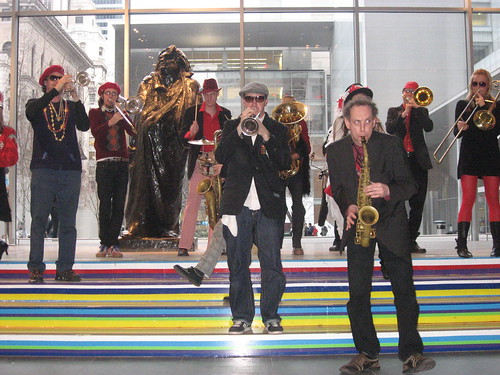
Saw the Hungry March Band at MOMA today. Quite a sight. This Flickr Set by ThisWeekInNewYork has photos from the Hungry March Band at MOMA.
I am a huge fan of gypsy-punk and brass bands who play in contemporary contexts like nightclubs and warehouse parties. I find a lot of pop music too slick - when I hear tunes on the radio or MTV I can almost hear the producers moving the sliders, twisting the knobs, making take-after-take, pitch-correcting and time-shifting every moment to produce the perfectly polished feel of the Music Industrial Complex.
It's hard to do that with a marching band. Bands like the Hungry March Band and the Luminescent Orchestrii reference older forms and traditions... things that are defiantly untrendy like brass instruments and plastic whistles. It is a sound that is a bit more ragged, it hasn't been fully overtaken by the MIC.
Appropriating these sounds within a contemporary context like a warehouse party is rad. Who would have known that a brass band can PUMP IT! One of Hungry March Band's best tricks is that the band members mix in with the crowd, they march around anarchically. They are not up on the stage, and do not follow a set pattern. This tactic, too, downplays image, it emphasizes the visceral qualities of sound. The sound is all around you and there is no one place to focus your gaze. You quickly become lost in the dance.
It was strange to see them at MOMA. There, too, they interfered with the workings of image. The museum guards seemed determined to keep to keep the visitors and the musicians separate, to preserve the sanctity of the performance space. Meanwhile, the musicians mixed and moved, avoiding the hierarchy.
Upstairs, while staring at paintings, you could hear the trombone.
Feb 7, 2008
NYFA Live meeting
I recently learned about NYFA Live. It is a $45 dollar 50 minute one-on-one consultancy where you meet with an advisor who talks about what to do next in your career. I found out about it on NYFA's website in the "NYFA Learning Workshops" section, or go here (you need to sign in to NYFA to reach that page).
I was excited by this prospect. One of the downsides of the Goldsmiths MFA program is that they offer no vocational training. They don't teach you how to write statements or applications, or how to think strategically about advancing your art career. They focus on the art, and leave it up to the artist to figure out how to make art a career.
I went for my NYFA Live session today. I met with Nick Stillman. He was smart, informed, and juggling with many of the same issues I juggle with, so I felt it was a useful match.
Nick offered several good pointers. In addition to the work I was already doing, he suggested I look for residency opportunities outside of the city, particularly the smaller residencies, since they are a good place to meet artists and network, and from there you can move to larger residencies. Nick also suggested I should sign up for curated artist registries such as The Drawing Center and White Columns. He felt that the open artists websites were much less useful.
He was very encouraging about my practice, saying he thought the work was strong, he liked the statement I showed him. Overall, it was a good pep talk, and gave me confidence that I was doing essentially the right things.
However, meeting with one person once for 50 minutes is not really enough - what you really want is meetings every three or four months with the same advisor. For example, meeting with an advisor who knows your work to review a major application just before it is due would be amazing. A single session with someone who doesn't know your work can only provide general guidelines, the kind of things that can easily be gleaned from the web.
Update: I tried to schedule a followup meeting with Nick a few months later, unfortunately he has left NYFA. I'm glad I did the NYFA Live session, but I don't really think it is worth the money and I probably won't do another.
Jan 20, 2008
St Ives

Here's the view from where I am staying in just now in St Ives, Cornwall, in the UK. The light is really amazing. The Atlantic roars all night long. We rented this flat from holidaylets.net and it has worked out well. My mother Sarah Meyer took the photo of me below, being blown by the wind.
 I spent a morning at the St Ives School of Painting, attending a life drawing session. It was a step back in time, the model standing by an old electric heater so as to stay warm, worn benches, floor splattered with years of paint.
St Ives is an ideal place for artists to visit for a winter holiday. Summer is too noisy and hectic here, you can hardly move down the streets. In January, the weather is dramatic but not too cold, the tourists are away, you can get better off-season prices, and the locals are friendly and relaxed.
There is a Tate St Ives museum here, in what is a small town, because St Ives was home to many important British abstract artists. Barbara Hepworth lived here, and her home studio is now a museum, well worth visiting. We went to the Kenneth Martin and Mary Martin show at the Tate, and I learnt more about Constructed Abstraction, a movement that started in the 1940s that resonates with my own art practice. I don't share these artists's admiration for the "beauty" of mathematics, but appreciate how they allowed systems to enter into their art making.
Nov 19, 2007
On the cover of Cluster Arts Magazine

I was invited to create the image for the cover of the first issue of Cluster Arts Magazine.
Usually in art magazines, the artist first creates an image, then a writer writes about it, and finally a designer lays out the image and text on the page. I thought it would be interesting to see what happens if this process is reversed. I proposed to editors Ana Cavic and Renee O'Drobinak that we commission a piece of text, have the magazine designer create a basic empty layout, and then I would use these two elements as inputs in my process - to create a "dot-to-dot" diagram using the same number of dots as words in the text.
Surprisingly, the editors said yes - and we created a cover image following this pattern. In the end, however, the editors opted for a simpler image without the words for the final cover... I hadn't really expected to be given the final say, but it was fun to try and I am pleased with the resulting cover.
Nov 10, 2007
Badiou speaking in New York
Alain Badiou is speaking at Law and Event, Benjamin N. Cardozo School of Law, Nov 11 & Nov 12. It's a public event. [link].
Followup
I went to Badiou's keynote this morning. He produced a handout entitled "A formalized presentation of the three meanings of negation", with the following symbols:
~ : negation

^ : and

v : or

[] : it is possible that...

P: a sentence
And this table
| Logics | Non-Contradiction | Excluded middle |
|---|---|---|
| Classical | ~(P ^ ~P) | (P v ~P) |
| Intuonistic | ~(P ^ ~P) | [] ~(P v ~P) |
| Para-consistent | [](P ^ ~P) | (P v ~P) |
Goldsmiths MFA 2007 Update
Since moving back to NY, I've been in touch with various classmates from my MFA at Goldsmiths via Google Chat:
Erin Crowe is currently in Bahrain, where she mentioned that she has a great studio setup.
Frog Morris remains as nutty as ever. He told me has was happy with his new Goldsmiths degree, and even more happy it was behind him. Pretty much how I feel.
Lawman Lok is back in China, said he is happy to be home, though missing the folks from Goldsmiths.
Yaron Lapid showed me some new work he is making. Along with Chia En, he is in a screening at Whitechapel Gallery.
I also visited the websites of my Goldsmiths MFA Fine Art 2007 classmates (see the links in the sidebar of this blog). The video artists seem to have been particularly active since our degree show. Here's some links to various people with shows:
Tu Pei Shih lists screenings in Amsterdam, London, Weimar, Spain, Sweden, France and the Netherlands... a global effort.
Chia En Jao has also managed no less than seven shows since the MFA show in July, along with Alexandra Navratil.
Paul Allsopp and Andy Weir have an upcoming show in Brighton, Fri Nov 23rd 6-9pm, Permanent Gallery. Their work has also toured the world since our show, going to London, Paris, Istanbul and Vienna.
Jorg Obergfell is having a show at the White Cross Gallery, and another at Seven Seven (see his website for details). He is also heading off to be an Artist in Residence in Seoul. I can just picture Jorg climbing sculptures in Seoul.
Hillel Roman is back in Isreal, judging from his website, which lists two upcoming shows there (but doesn't give dates or details).
Yohei Yashi and Maria-Brigita Karantzi are in the upcoming Bloomberg New Contemporaries show in Manchester, November 23.
Quite a few people haven't put up websites yet, or their sites are not updated - if you start a website or blog, let me know! Or if you know if news or updates, add a comment - or drop me an email (jonmeyer at gmail).
Nov 8, 2007
Mariko Mori at Deitch
.jpg)
Went to an art opening at Deitch Projects by Mariko Mori.
The wall text proudly announced that Tom Na H-iu (the glowing orb above) is connected via the Internet directly to the world's largest observatory in Japan, and that the piece is a live visualization of the neutrino data from that lab.
Whenever I see art visualizing data from the Internet, I think of Natalie Jeremijenko's famous Live Wire project from 1997.
Natalie's piece showed data that everyone could directly relate to (the amount of traffic over the network in an office, corresponding to how busy everyone is). The visualization was very simple: The amount of network traffic controls the speed of a stepper motor. A clear single variable, shown using one dimension of movement. The visualization made perfect sense: the more traffic, the more the wire dances about. Yet it was also surprising, revealing a usually hidden dimension of our daily cycle.
Unfortunately, when most artists make Internet data visualizations, they do what Mariko did. She took a piece of data we are so unfamiliar with that nobody could tell the difference between real and made up data. Then she presented it using a visualization so abstract it needed wall text to explain it. At that point, why not make it up? Nobody will call you on it.
The piece was beautiful, but all the wall text about neutrinos and live Internet data was just a way to prop the work up with some pseudo-scientific claims. Better to just to say "we made a giant ten foot tall Lava lamp."
Nov 7, 2007
Remediality and Adorno
Tonight we relaunched Remediality, a critical theory reading group I run. It's the first New York session since 2005 (we ran several sessions at Goldsmiths earlier this year, they proved quite popular).
Present were: Spiros, Ryan, Emanuel, Tom, Friedrich and myself.
We read from chapter 1 of Horkheimer & Adorno's Dialectic of Enlightenment, first published in 1944.
As Ryan succinctly put it, H+A argue that the Enlightenment is baaad. Linked with this, they offer a somewhat romantic view of the primitive pluralism that came before the Enlightenment. A few of their passing shots against Enlightenment and logos:
"Enlightenment is totalitarian."
"Only thought which does violence to itself is hard enough to shatter myths."
"Bourgeois society is ruled by equivalence. It makes dissimilar things comparable by reducing them to abstract quantities. For the Enlightenment, anything which cannot be resolved into numbers, and ultimately into one, is illusion; modern positivism consigns it to poetry."
Horkheimer and Adorno make a connection between art, magic and mana (life force) - suggesting that art is a form of magic.
"Just as the sorcerer begins the ceremony by marking out from all its its surroundings the place in which the sacred forces are to come into play, each work of art is closed off from reality by its own circumference. The very renunciation of external effects by which art is distinguished from magical sympathy binds art only more deeply to the heritage of magic. This renunciation places the pure image in opposition to corporeal existence, the elements of which the image sublates within itself. It is in the nature of the work of art, of aesthetic illusion, to be what was experienced as a new and terrible event in the magic of primitives: the appearance of the whole in the particular. The work of art constantly reenacts the duplication by which the thing appeared as something spiritual, a manifestation of mana. That constitutes its aura."
Art as transcendental, as pure image, as aesthetic illusion, aura - is it just me, or is this the groundwork for the modernist Greenbergian world order that was to follow?
If people want the full text, I have it as a PDF file...
Nov 6, 2007
Setup a home studio
 I've installed a small studio in my home as a stop-gap until I find a longer term solution.
See this post for a longer story on building the studio.
I've installed a small studio in my home as a stop-gap until I find a longer term solution.
See this post for a longer story on building the studio.
Subscribe to:
Posts (Atom)

 Posts
Posts

